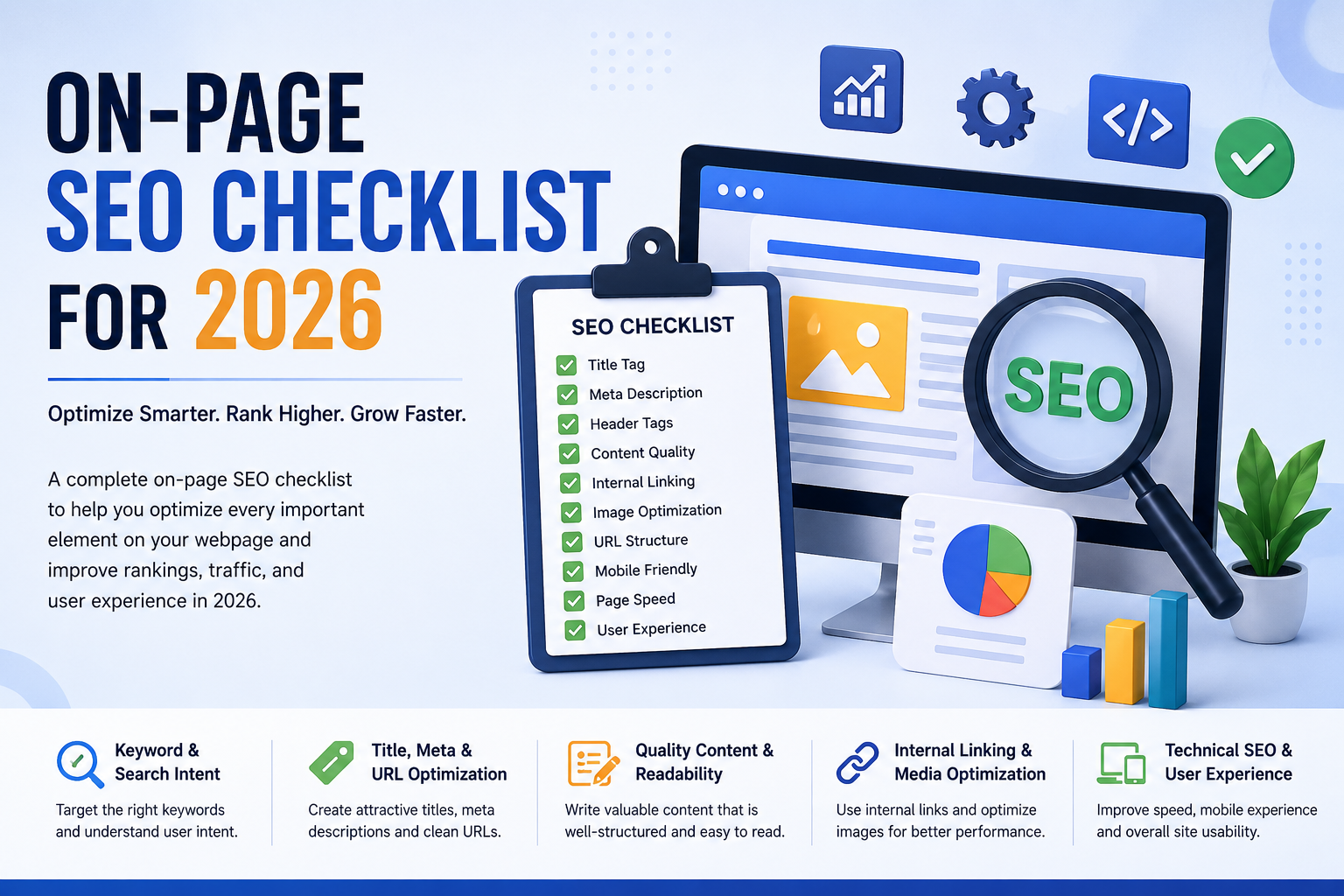
Complete On-Page SEO Checklist for 2026 to Improve Rankings and Organic Traffic
Improve your website rankings and organic traffic with this complete On-Page SEO Checklist for 2026. Learn the latest SEO strategies, content optimization techniques, technical SEO practices, and user experience factors for better search visibility.
Why On-Page SEO Matters in 2026
On-page SEO is the act of tuning individual webpages so that search engines can rank them higher, show them more often, and bring in organic traffic. In 2026, SEO is not just about sprinkling keywords somewhere in a webpage, like that alone. Search engines now look much more closely at user experience, content quality, how relevant the page feels, and the technical speed of things, too.
Newer search algorithms basically watch how people move through a page, whether the answer is genuinely useful or not, and whether the content really clicks with the user’s search intent. Sites that keep up with updated on-page SEO habits tend to do better in rankings, get steadier engagement, and keep growing over time.
And yeah, when a page is optimized in the right way, it does more than just help visibility in search engines. It also makes it easier for visitors to browse, find what they need, and helps build a bit of confidence in the website overall.
Start With Search Intent and Keyword Research
Keyword research is still like the bedrock of successful SEO, but honestly, grasping search intent is just as vital, maybe more. Before businesses start writing or building pages, they should first figure out what people are actually searching for and also why they are looking for it in the first place.
Search engines today tend to prefer content that answers real questions naturally, not pages that look like they were crammed with the same repeated terms. When you use primary and related keywords in titles, headings, meta descriptions, and throughout the body copy, it boosts relevance without making everything feel forced or unnatural.
Also, long-tail keywords along with semantically related phrases help a site show up across many search variations, and they strengthen overall topical authority over time.
Optimize Titles, Meta Descriptions, and URLs
Title tags and meta descriptions kinda play an important role in SEO and also in user engagement. A well-written title will clearly explain what the page is about, while still putting the main keyword in there in a natural way. Meta descriptions should summarize the content in a short, simple manner and motivate users to click through from the search results. Even though meta descriptions are not direct ranking factors, they can really affect click-through rates.
For URLs, they should stay clean, short, and descriptive. When the URL structure is simple, it helps readability, and also makes it easier for search engines to understand what the webpage topic is, you know.
Example:
yourwebsite.com/on-page-seo-checklist
Focus on Content Quality and Readability
In 2026, content quality is still kinda one of the strongest ranking factors, and search engines seem to reward it again and again. They lean toward material that is informative, precise, genuinely useful, and not overly complicated to read. Also, it helps if the whole thing flows, because well-structured content makes the experience smoother, and the users tend to stay around longer.
When paragraphs are short, headings are clear, and the explanations feel natural, the reading journey stays engaging. People don’t bounce as fast, and that’s a big deal. Instead of producing content only for search engines, businesses really should write for actual humans, to help people fix a problem or learn something practical. Human-friendly content usually does better, since it boosts engagement signals like time on page and interaction rate.
So yeah, the main idea is pretty simple: write clearly, answer what readers need, and keep everything easy to digest.
Improve Internal Linking and Media Optimization
Internal linking sort of helps visitors stumble onto nearby pages, and it also lets search engines better read how the site is laid out. When internal links are done right, navigation feels smoother, and that authority ends up being spread across the key pages, not just sitting in one place.
Image and other media optimization are just as essential for SEO results. If images are huge or not optimized, pages can feel sluggish, and the user experience takes a dip.
With descriptive file names, accurate alt text, compressed pictures, and responsive media formats, you end up improving accessibility, speeding up load times, and supporting the overall website performance picture.
Prioritize Technical SEO and User Experience
Technical SEO mixed with user experience has become sort of the big ranking deal lately. Search engines look at how fast webpages load, how well they behave on mobile, and how simple it is for people to interact with what’s on the page. When sites load quickly, you often get a smoother feel for visitors, and bounce rates go down, even a little. Mobile responsiveness is also huge since most people, honestly, browse through smartphones now.
On top of that, HTTPS for safe browsing matters, along with fixing broken links, tightening up Core Web Vitals, and keeping a tidy website structure. All of that together helps your SEO strength stay solid and can improve search visibility.
Keep Content Updated Regularly
Keeping your website content updated regularly kind of helps it stay relevant and accurate, not just in theory but in practice. Search engines tend to favor sites that show fresh and updated details for visitors.
When you go back to older pages and give them a refresh with new data, better formatting, and tuned keywords, plus some added context or new information, it can support your rankings over time. It’s like you’re revising the whole narrative a bit, not only the surface.
Also, doing this in a consistent way tends to signal that the website is still active, useful, and worth visiting, even after a while.
Final Thoughts
On-page SEO in 2026 is not really about just keywords in the right spots. It’s more like the whole success thing depends on content quality and how easy it is to read, plus matching the exact search intent, and then also technical bits, plus page experience, and how users actually behave once they land there.
Websites that bring useful, specific details with a tidy SEO structure are more likely to climb rankings, get stronger organic traffic over time, and keep a stable presence online. And yes, if you follow a full-on-page SEO checklist, businesses tend to stay competitive while improving the entire website performance as the digital world keeps changing.